In a surprise twist of plans, I ended up going to the final day of the Royal Academy Summer Exhibition today. (I was meant to be going on a blind date, who cancelled on me with 30 minutes to go; so I took matters into my own hands and took myself on a date to the RA!)
There is something electric in the brave eclecticism of the Summer Exhibition, that has made it a staple of the annual London cultural diet. It’s not often you see works by esteemed, well-known artists alongside those of emerging artists, on quite such a scale. Over 1,200 pieces are on display, in media ranging from pencil and pen, to acrylic and watercolour, and from sculpture and architecture to video, and everything else in-between.
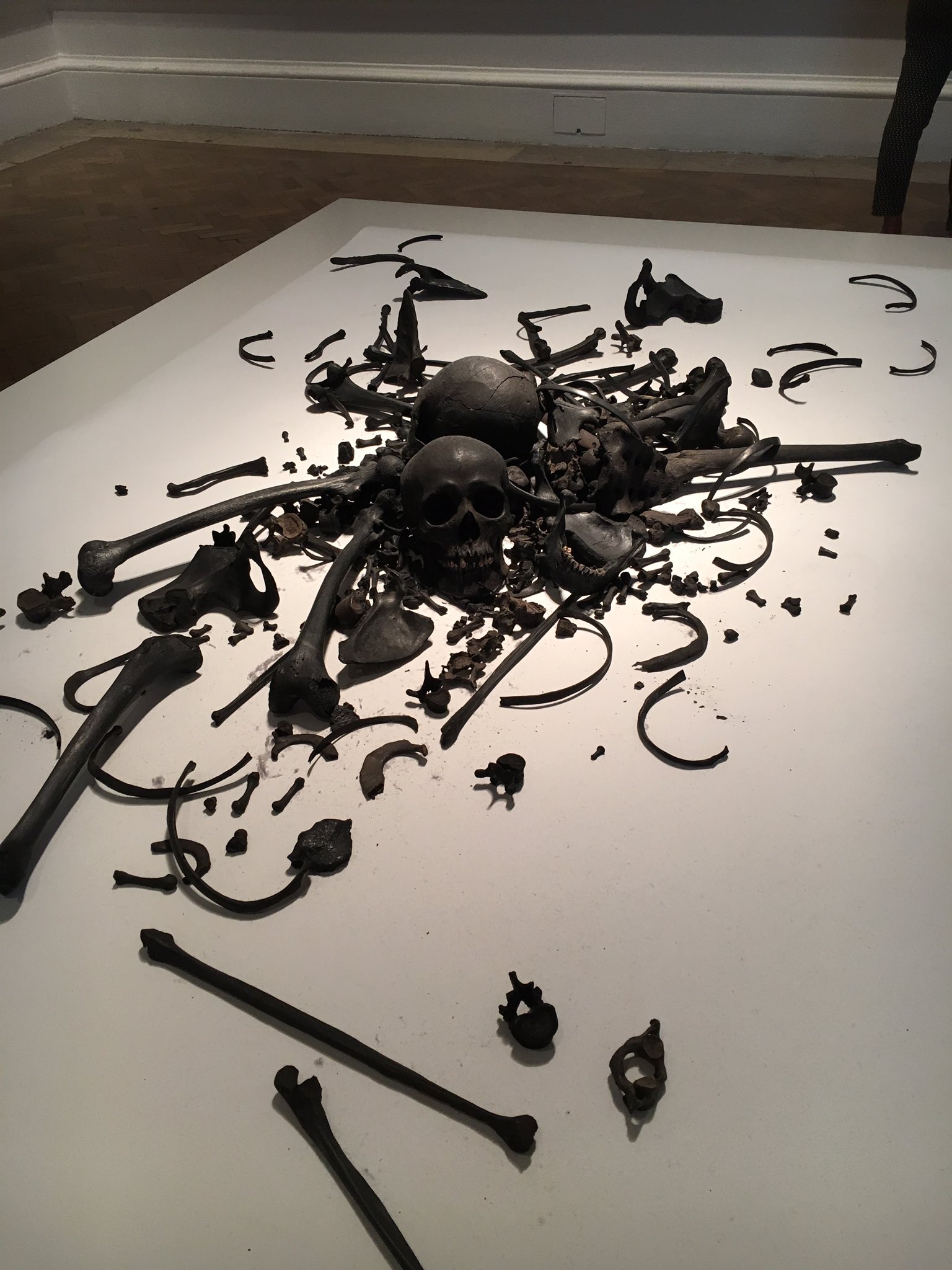
SELF PORTRAIT AS CHARCOAL ON PAPER by Zatorski + Zatorski
A notable feature this year is the prevalence of artistic duos exhibiting work, specially invited by the exhibition co-ordinator, Richard Wilson RA. One of my favourites of these double acts was “Self Portrait as Charcoal on Paper” by Zatorski + Zatorski.
This eerie piece, rather morbid at first, manages to be quite cool in how it has taken a literal interpretation of the concept of a self-portrait: an artwork made up by elements of the self in the form of the remnants of a body. And yes, those are actual skeletons. According to the RA Summer Exhibition catalogue, the piece is made of “carbonised male and female human skeletons, drawing paper and gold” (the gold bits being false teeth). So it really is an artwork done in charcoal, but not the way we’re used to. This piece is jarring and thought-provoking around the concept not only of art and self-portraits, but in terms of self and whether we remain “ourselves” once we’ve died, and once our bodies start changing after death.


As with many exhibitions, I found there was just so much to take in at the Summer Exhibition. (What doesn’t help, I think, is the hanging of some works so high up you either miss them entirely or it becomes quite a challenge to take them in. I know, I know, they’re in the catalogue, but nothing beats seeing it “in the flesh”, at a distance and at an angle that allows you to fully experience the work.) I don’t want to call for smaller exhibitions necessarily, but I must admit to struggling to taking it all in, and at times (at this exhibition and others) I do find myself wondering whether there is more to be gained from smaller, concentrated exhibitions that allow you to get more involved with fewer pieces.
 Joanne Pohl